How We Really Retain Knowledge – and Why Cramming Does Not Work
Studying something only to forget it again the next day?
Many university students, school students, and trainees are familiar with this problem. Shortly before an examination, they try to force all the material into their memory. Only a few weeks later, very little of it remains.
What goes wrong – and how does sustainable learning really work?
Cramming: When Knowledge Simply Passes Through
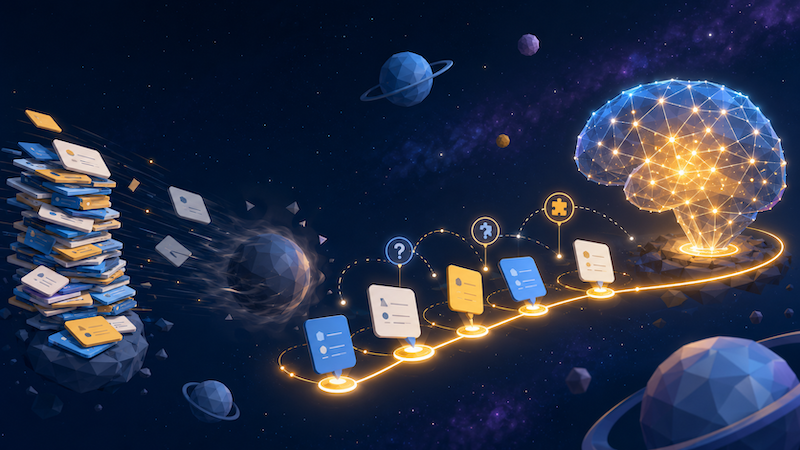
Cramming describes the short-term memorisation of large amounts of material with the aim of reproducing it during an examination and quickly forgetting it afterwards.
At best, this method may result in a good grade. However, it fails whenever understanding, application, or long-term knowledge is required – for example, in professional life, advanced university courses, or interconnected thinking.
Content learned without deeper processing frequently remains only in short-term memory and is quickly forgotten.
How Our Brain Really Learns
The brain does not store information in isolation or in a simple linear structure. Instead, it creates networks of connected knowledge.
Repetition, active application, and personal or emotional relevance all play an important role.
Three principles are particularly important for retaining knowledge over the long term.
1. Spaced Repetition – Reviewing at Intervals
Instead of trying to learn everything in one night, it is far more effective to review content at regular and increasingly longer intervals.
This repeatedly trains your ability to recall the information. It also reinforces the material before it has been completely forgotten.
2. Active Recall – Retrieving Knowledge from Memory
Instead of repeatedly reading a text or simply highlighting important passages, you should try to retrieve the information actively from memory.
Useful methods include:
- quiz questions
- flashcards
- self-tests
- practice exercises
- explaining a topic in your own words
Active recall strengthens memory connections and reveals which topics you already understand and where knowledge gaps remain.
3. Transfer and Application
Applying what you have learned in new contexts leads to deeper processing and better long-term retention.
Possible forms of application include:
- practical exercises
- discussions
- projects
- case studies
- applying a theory to a new situation
- explaining a concept to someone else
This means that knowledge is not simply reproduced. It is genuinely understood and can be used flexibly.
Learning Playfully and Sustainably
This is precisely where Learn Battle comes in. The learning platform combines research-based learning methods with motivating game elements.
Learn Battle provides:
- reviews at appropriate intervals through spaced repetition
- quiz-based questions for actively retrieving knowledge
- game modes, battles, and challenges that support motivation
- progress analytics focused on understanding rather than memorisation
- immediate feedback on correct and incorrect answers
- small learning goals and rewards for continuous progress
Whether you are at university, at school, or completing vocational training, Learn Battle helps you retain knowledge over the long term – with less examination stress and greater enjoyment of learning.
Learning Better Means Learning Differently
Building knowledge requires time, repetition, and the right learning methods.
Cramming is not a sustainable strategy. Modern learning platforms such as Learn Battle demonstrate that long-term learning can be both more effective and more motivating.
Instead of memorising large amounts of material shortly before an examination, you should:
- begin studying early
- divide the material into small units
- review content regularly
- test your knowledge actively
- apply what you have learned to new situations
- monitor your progress regularly
This transforms short-term examination knowledge into genuine understanding that remains useful in the future.
Get Started
For University and School Students
Download Learn Battle for free
For Teachers, Lecturers, and Professors
Create content and monitor learning progress in Learn Battle Studio